Table of Contents
By Michelle K., 34, Marketing Director
I spent $3,000 on PMS treatments in 2022.
Acupuncture sessions, specialized teas, expensive probiotics, hormone testing, naturopathic consultations, elimination diets – you name it, I tried it. I had a bathroom cabinet that looked like a pharmacy and a monthly calendar color-coded with my symptoms that read like a medical textbook.
For fifteen years, I’d been held hostage by my cycle. Two weeks of feeling normal, two weeks of what I can only describe as emotional and physical torture. I’d tried birth control (made me gain 30 pounds and feel numb), antidepressants (helped the mood but killed my sex drive), and countless “miracle cures” I found on wellness blogs.
Then, in December 2022, my naturopath suggested a simple four-supplement stack that cost less than $40 a month. I almost didn’t try it because it seemed too basic, too cheap, too simple after years of complex protocols.
It changed my life in three months.
The PMS That Ruled My Life
Let me paint you a picture of what my PMS looked like before I found this stack, because I know some of you reading this are living the same hell I was.
Week 3 of my cycle: The anxiety would start creeping in. Little things that normally didn’t bother me – a delayed email response, my husband leaving dishes in the sink – would trigger this low-level panic that something was terribly wrong. I’d start catastrophizing everything: my job performance, my relationships, my health, my future.
Week 4: Full meltdown mode. I’d wake up feeling like I was wearing a weighted blanket made of sadness. My breasts would be so tender I couldn’t wear a bra. My stomach would bloat until I looked six months pregnant. But the mood symptoms were the worst part – crushing depression mixed with rage that felt completely out of proportion to anything happening in my life.
I’d cry at commercials, pick fights with my husband over how he loaded the dishwasher, and genuinely consider quitting my job because I convinced myself everyone hated me. Then, the day my period started, it was like someone flipped a switch. I’d feel normal again and spend the next two weeks apologizing to everyone and wondering what the hell was wrong with me.
This pattern repeated every single month for fifteen years.
The Breaking Point
The final straw came during a work presentation in November 2022. I was in the middle of pitching a campaign strategy to a room full of executives when my brain just… stopped working. The infamous PMS brain fog hit so hard I literally forgot what I was talking about mid-sentence.
I stood there for what felt like an eternity (probably 10 seconds) completely blank, then mumbled something about needing to reference my notes. I could see the confusion and concern on my colleagues’ faces. I somehow stumbled through the rest of the presentation, but I knew I’d blown it.
After the meeting, I locked myself in the bathroom and cried. Not the gentle, cathartic kind of crying – the ugly, can’t-catch-your-breath sobbing that comes from feeling completely broken and hopeless.
“I can’t live like this anymore,” I texted my best friend. “I’m 34 years old and my period is ruining my career.”
That night, I made an appointment with Dr. Sarah Chen, a naturopathic doctor who’d been recommended by three different friends. I was skeptical – I’d been down the naturopathic route before and spent hundreds of dollars on protocols that didn’t work. But I was desperate.
The Appointment That Changed Everything
Dr. Chen was different from other practitioners I’d seen. Instead of immediately ordering expensive tests or recommending complex protocols, she spent two hours just listening to my story and asking detailed questions about my symptoms.
“Based on what you’re describing,” she said, pulling out a piece of paper, “I think we can get you significant relief with four basic supplements that address the root causes of your symptoms. Before we do anything fancy or expensive, let’s try the fundamentals.”
She explained that severe PMS often comes down to a few key deficiencies and imbalances:
Magnesium deficiency: “About 75% of women are deficient in magnesium, and it gets worse during your luteal phase. This causes anxiety, insomnia, muscle tension, and mood swings.”
B vitamin depletion: “B6 specifically is crucial for serotonin production. When you’re low, you get depressed, anxious, and irritable.”
Essential fatty acid imbalance: “Your brain needs omega-3s to regulate inflammation and mood. Most people get plenty of omega-6s from processed foods but not enough omega-3s.”
Blood sugar dysregulation: “Hormonal changes during PMS make you more sensitive to blood sugar swings, which worsen mood symptoms and cravings.”
“We’re going to support all four of these areas with targeted supplements, and I predict you’ll see a 70% improvement in your symptoms within three months,” she said confidently.
I was skeptical but willing to try anything at that point.
The Magic Four: My Supplement Stack
Here’s exactly what Dr. Chen prescribed, with specific dosages and timing:
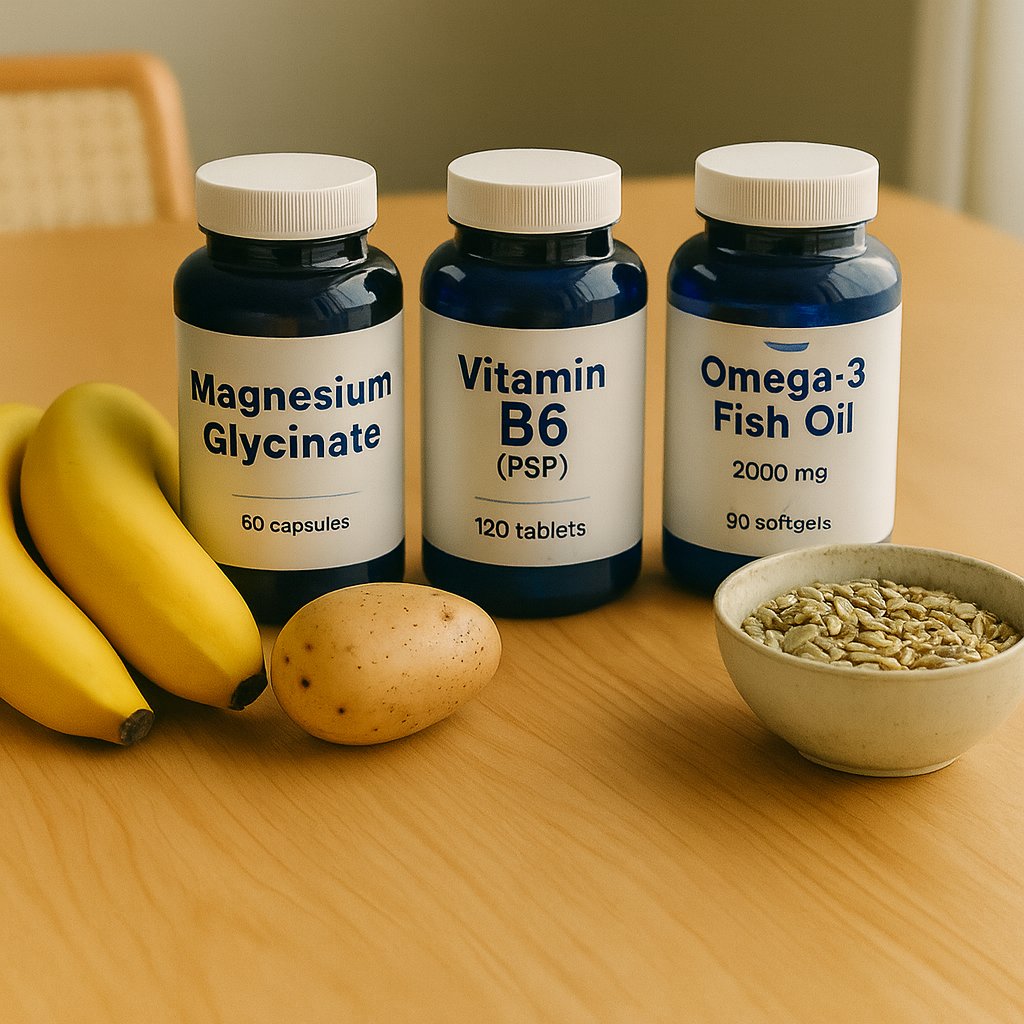
1. Magnesium Glycinate – 400mg before bed “This is the most bioavailable form of magnesium,” she explained. “It will help with sleep, anxiety, muscle tension, and those chocolate cravings. Take it at night because it’s naturally calming.”
2. Vitamin B6 (P5P form) – 50mg with breakfast “P5P is the active form that your body can actually use. This supports serotonin production and helps with mood regulation and bloating.”
3. Omega-3 Fish Oil – 2000mg with dinner “Look for one that’s at least 60% EPA/DHA combined. This reduces inflammation and supports brain health. Take with fat for better absorption.”
4. Chromium Picolinate – 200mcg with lunch “This one surprises people, but it’s amazing for blood sugar stability and reducing sugar cravings during PMS.”
The total cost? $38 per month from a reputable online supplement company. Less than what I used to spend on one acupuncture session.
“That’s it?” I asked, staring at the simple list. “No special timing, no cycling on and off, no complicated protocols?”
“That’s it,” she smiled. “Sometimes the simplest solutions are the most effective. Take these every day, consistently, for three months. Track your symptoms. Then we’ll see what else you might need.”
Month One: Subtle but Promising Changes
I’ll be honest – I didn’t expect much the first month. I’d been disappointed by supplements before, and this seemed almost too simple to work for problems that had plagued me for fifteen years.
But about two weeks into taking the stack, I noticed something weird. I was sleeping better. Like, significantly better. I’d always been a terrible sleeper during PMS, tossing and turning with anxiety and restless legs. But I was falling asleep faster and staying asleep through the night.
My husband was the first to notice the mood changes. “You seem… calmer,” he said cautiously about three weeks in. “Like, less on edge.”
He was right. The low-level anxiety that usually started ramping up during my luteal phase was much more manageable. I still felt a bit more sensitive than usual, but it wasn’t the crushing, everything-is-terrible feeling I was used to.
The physical symptoms were improving too. My usual PMS bloating was maybe 50% less severe, and those painful breast tenderness that made hugs unbearable was noticeably better.
When my period came that month, I realized something shocking: I’d made it through my luteal phase without a single crying meltdown. That hadn’t happened in years.
Month Two: Undeniable Progress
By the second month, the changes were impossible to ignore. My energy levels during PMS week were almost normal. The brain fog that had embarrassed me during that work presentation was maybe 20% of what it used to be.
But the most dramatic change was my mood stability. I tracked my daily mood on a 1-10 scale, and while I still dipped lower during my luteal phase, I wasn’t experiencing those dramatic crashes where I felt suicidal or wanted to divorce my husband over minor annoyances.
“It’s like someone adjusted the volume on my emotions,” I told Dr. Chen during my follow-up appointment. “I still feel things, but they’re not overwhelming.”
The cravings were different too. I still wanted chocolate during PMS, but it was a normal “this sounds good” craving, not the desperate, drive-to-the-store-at-10-PM-for-emergency-candy kind of craving that used to control me.
My coworkers started commenting that I seemed more consistent. “You’re not having those rough weeks anymore,” my manager mentioned during my performance review. “Your work quality has been really steady.”
Month Three: The Life-Changing Realization
Month three was when I truly understood how much my life had changed. I was tracking my cycle as usual, noting when my luteal phase began, and I realized something incredible: I’d forgotten to dread it.
For fifteen years, I’d approached the second half of my cycle with anxiety and preparation for the emotional storm that was coming. I’d warned my husband, cleared my social calendar, and braced myself for two weeks of misery.
But this month, my luteal phase came and went without me really noticing. I had some mild breast tenderness and wanted extra sleep, but that was it. No depression, no anxiety, no rage, no brain fog.
I called Dr. Chen, almost in tears. “I think I’m fixed,” I said. “I just had the easiest PMS of my adult life.”
“How do you feel about continuing the supplements?” she asked.
“Are you kidding? I’m never stopping these. Ever.”
The Science That Convinced Me
After experiencing such dramatic results, I dove deep into the research behind each supplement. What I found convinced me that this wasn’t placebo effect – this was solid science:
Magnesium studies show that supplementation can reduce PMS symptoms by up to 38%. Women with PMS are consistently found to have lower magnesium levels than women without PMS.
Vitamin B6 research demonstrates that 50-100mg daily can significantly improve mood symptoms, with some studies showing improvements comparable to antidepressants for PMS-related depression.
Omega-3 clinical trials have found that fish oil supplementation reduces PMS symptoms by an average of 30-50%, particularly mood symptoms and breast tenderness.
Chromium studies show that 200-400mcg daily can reduce sugar cravings by up to 50% and improve mood stability in women with PMS.
The more I read, the more I understood why this simple stack had worked when so many other treatments hadn’t. These weren’t random supplements – they were targeting the specific biochemical imbalances that cause PMS symptoms.
One Year Later: The Numbers Don’t Lie
I’ve now been taking this supplement stack for over a year, and I’ve tracked everything. Here are my actual numbers:
Before supplements:
- Severe mood symptoms: 10-12 days per month
- Days unable to work effectively: 3-4 per month
- Relationship conflicts during PMS: 4-6 per month
- Sleep quality (1-10 scale): Average 4 during luteal phase
- Energy levels during PMS (1-10): Average 3
After supplements:
- Severe mood symptoms: 1-2 days per month (if any)
- Days unable to work effectively: 0-1 per month
- Relationship conflicts during PMS: 0-1 per month
- Sleep quality during luteal phase: Average 8
- Energy levels during PMS: Average 7
The improvement is undeniable. I went from being functionally disabled for half of every month to having mild symptoms that don’t interfere with my life.
What I Learned About Quality and Timing
Not all supplements are created equal, and I learned this the hard way when I tried to save money with cheaper versions of my stack.
Quality matters. I switched to a cheaper magnesium supplement and my sleep problems came back within two weeks. The form of the supplement matters – magnesium glycinate is much better absorbed than magnesium oxide, which is what’s in most cheap supplements.
Consistency is everything. I tried taking “supplement breaks” a few times and always regretted it. My symptoms started returning within 2-3 weeks of stopping.
Timing can help. Taking magnesium at night maximizes its sleep benefits. Taking B6 with breakfast gives you energy support throughout the day. Omega-3s with dinner aid absorption.
Start slowly. When I increased my fish oil dose too quickly, I got mild stomach upset. Building up gradually over 2-3 weeks avoided this issue.
The Skeptics and Side Effects
I’ve had friends roll their eyes when I share my story. “It’s probably just placebo effect,” one said. “You wanted it to work so badly that you convinced yourself it was working.”
To them I say: track your symptoms for fifteen years, then tell me I imagined a 90% improvement that’s sustained for over a year.
As for side effects, I’ve had almost none. Occasionally, if I take the fish oil on an empty stomach, I get mild burping (gross but harmless). The magnesium sometimes makes me sleepy if I take it too early in the evening, so I time it closer to bedtime now.
The only “side effect” has been that my friends and family prefer the version of me that takes these supplements. “Please don’t ever stop taking those,” my husband said recently. “I love you either way, but I love how much happier you are now.”
What This Didn’t Fix (And What It Did)
I want to be clear about what this supplement stack did and didn’t do for me:
What it fixed:
- Mood swings and emotional instability
- Anxiety and depression during luteal phase
- Sleep problems and insomnia
- Brain fog and concentration issues
- Severe bloating and breast tenderness
- Sugar cravings and emotional eating
- Relationship conflicts during PMS
What it didn’t fix:
- I still get mild cramps (but they’re manageable with ibuprofen)
- I still prefer to take things easier during my period
- I still notice some energy fluctuations throughout my cycle
- I still occasionally want chocolate (but it’s a normal craving, not an obsession)
The difference is that my cycle went from being a monthly crisis to being a minor inconvenience. I’m still aware of it, but it doesn’t control my life anymore.
My Advice for Women Considering This
If you’re thinking about trying this supplement stack, here’s what I wish someone had told me:
Give it three full months. Don’t expect overnight miracles. It took my body time to build up nutrient stores and regulate properly.
Track your symptoms. Keep a simple daily log of mood, energy, and physical symptoms so you can objectively see improvements.
Don’t cheap out on quality. Invest in reputable brands with third-party testing. The forms I mentioned (magnesium glycinate, P5P B6, etc.) are more expensive but more effective.
Talk to your doctor. Especially if you’re on medications. These supplements are generally safe, but it’s always good to check for interactions.
Be patient. Some months will still be harder than others, especially during times of stress. But overall, the trend should be toward improvement.
Don’t quit if you don’t see immediate results. I almost stopped after six weeks because the changes felt subtle. I’m so glad I stuck with it.
The Ripple Effects
Fixing my PMS didn’t just improve my menstrual cycle – it improved my entire life. When you’re not spending half your time feeling terrible, you have so much more bandwidth for everything else.
My work performance improved because I wasn’t missing days or struggling with brain fog. My marriage got stronger because we weren’t fighting every month. My friendships deepened because I wasn’t canceling plans or being moody. My overall mental health stabilized because I wasn’t on an emotional roller coaster.
I started exercising regularly again because I had consistent energy. I took on new projects at work because I trusted my ability to follow through. I even started planning vacations without obsessing over whether they’d coincide with my “bad weeks.”
To the Women Still Suffering
If you’re reading this and you’re where I was two years ago – desperate, exhausted, and feeling like your cycle is ruining your life – I want you to know there’s hope.
You don’t have to accept that PMS misery is just “part of being a woman.” You don’t have to plan your life around your symptoms or apologize for having normal biological processes that affect your mood and energy.
This simple supplement stack might not work for everyone, but it worked for me and it’s worked for the dozen friends I’ve shared it with. For $40 a month, it’s worth trying before you spend thousands on complex treatments.
Your quality of life matters. Your comfort matters. Your mental health matters. Don’t let anyone tell you that severe PMS is normal or that you just need to “deal with it.”
You deserve to feel good in your body every day of the month, not just for two weeks out of four.
Michelle K. has been PMS-free for over a year and considers her supplement stack one of the best investments she’s ever made. She’s not affiliated with any supplement companies and receives no compensation for sharing her story. Always consult with a healthcare provider before starting new supplements.
The Stack:
- Magnesium Glycinate 400mg (bedtime)
- Vitamin B6 (P5P) 50mg (breakfast)
- Omega-3 Fish Oil 2000mg (dinner)
- Chromium Picolinate 200mcg (lunch)
Total monthly cost: Approximately $38